
Kay County Booking Photos And Records
Oklahoma's Open Records Act defines records broadly enough to include photographs, but access still depends on the law-enforcement provision, other restrictions, and the custodian's review. A KCDC mugshot is the image created for a county booking. It can remain in agency records after the person leaves the jail.
A photo alone says nothing about release reason. Pair it with the booking number, release date and time, release code, and destination or receiving agency. Bond release, time served, court order, ODOC transfer, another-agency hold, and ICE movement are distinct results.
Find Kay County Release Mugshots
No single gallery covers every Kay County release. Each channel has its own scope. The official source depends on whether the image came from KCDC, ODOC, or a statutory registry.
| Channel | Has a photo? | How to access |
|---|---|---|
| KCDC release feed | No official feed verified | Request the booking image from KCSO/KCDC. |
| Sheriff mobile app | No app verified | Do not substitute an unrelated county app. |
| ODOC offender search | Yes, when the state record displays one | Search the official ODOC record. |
| Offender registry | For qualifying registrants only | Use the official statutory registry. |
| Local news | Sometimes | Treat dated reporting as a historical lead. |
| Private archives | Sometimes | Do not treat a copy as current official proof. |
A person released from KCDC without an ODOC commitment may have no state photo. A registry image applies only to someone subject to that registry. Search the correct system and verify identity beyond the name.
Request Kay County Booking Photos
Address a narrow request to the Kay County Sheriff's Office or KCDC, 1101 W. Dry Road, Newkirk, OK 74647. The Sheriff's phone is 580-362-3250, detention is 580-362-3393, and fax is 580-362-3259. No county online request form, photo fee, or set turnaround was published.
- Identify the full booked name, date of birth or booking number, and approximate booking date.
- Ask for “the booking photograph associated with booking number/date” and name the booking.
- Request the movement or release record with date, reason, and destination.
- Ask for electronic copies and notice before fees are incurred.
- If material is withheld, ask for the statutory basis and any separable public portion.
Under 57 O.S. § 62, commitment and liberation instruments are filed and kept by the sheriff or jailer. The photo request should remain linked to that event. Do not request biometric iris-scan data; local use of identification scans does not make biometric templates appropriate for publication.
Note: Request the ordinary booking image and movement record, not the biometric data used for facility identification.
Kay County Sheriff Photo Channels
The official sheriff page links Facebook and Kay OffenderWatch, but no jail roster, recent-release photo archive, or sheriff jail app was verified. Facebook is an announcement channel. It is not a complete record of all KCDC bookings or releases.
OffenderWatch and Oklahoma's sex or violent offender registries serve statutory registration. They do not show every released person. The successful manifest image comes from the official Violent Offender Registry disclaimer.
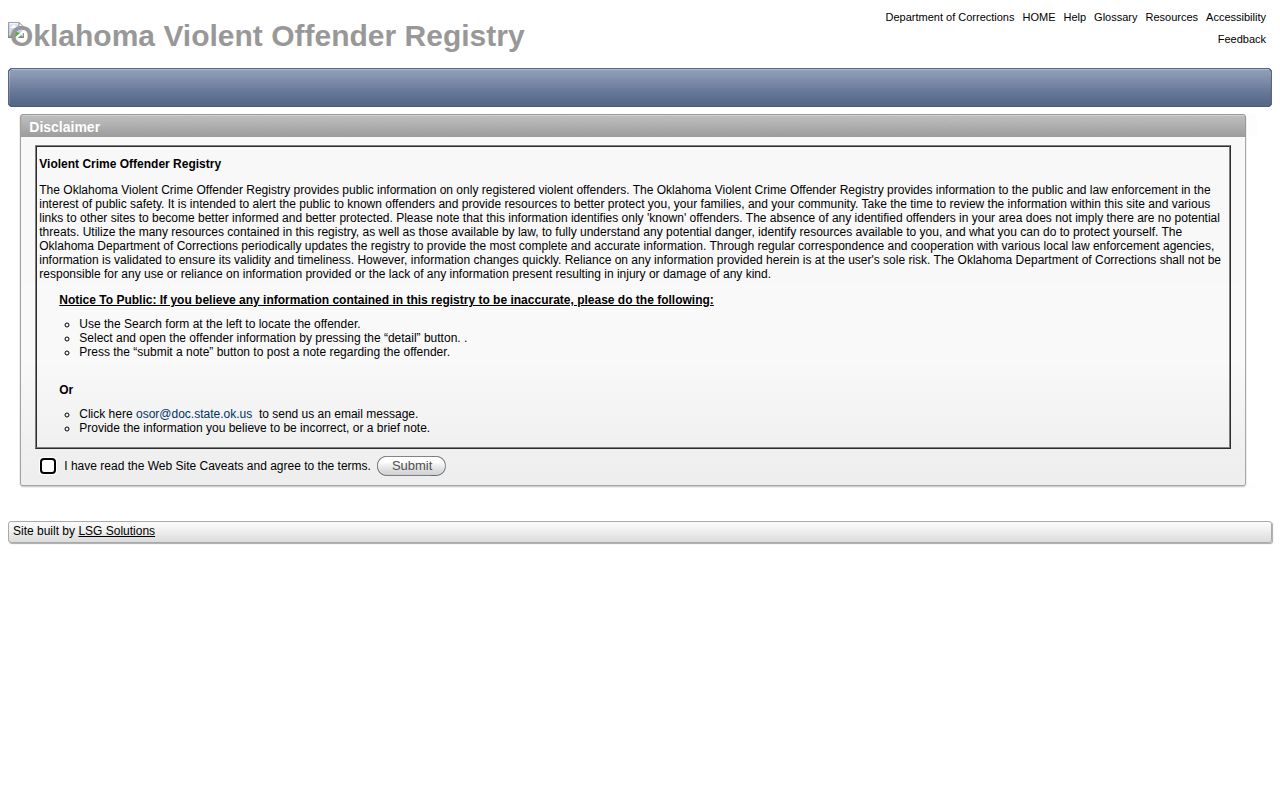
The disclaimer screen reinforces that registry photos have a defined legal purpose and cannot stand in for a general Kay County release-photo search.
Note: No match in a statutory registry says only that no matching public registration record was found there.
Kay County ODOC Offender Photos
ODOC policy confirms that the state public lookup can display an offender photo along with offense and projected-release data. That image belongs to the ODOC record. It is not necessarily the same photo taken during a KCDC booking, and a county detainee who never entered state custody may have no ODOC record.
Search by ODOC number when known. Otherwise compare the photograph, name, sentence, case, and identity details. Read current location or supervision separately from historical discharge. An old photo or discharged sentence does not establish current freedom from every other case or hold.
When a formal state image or discharge record is needed, ODOC Legal Services provides an Open Records form. Request the offender photograph and specific custody history, using the ODOC number and date range.
Kay County Historical News Photos
Kay NewsCow published KCDC-supplied booking and status information in earlier years. Those dated reports preserve local distinctions such as released on bond, held for another authority, BIA contract, weekend commitment, sanction, and an ODOC sentence. Some local news coverage may also contain a photo.
That reporting is not a complete current archive and may lack exact departure time. Its date and source must remain attached to any image. A historical article can lead to the right booking, but KCDC and the court must confirm the person, release event, and disposition. Local news should not be described as the legal custodian.
Private mugshot or roster copies may also remain online. They can be stale, misidentified, or detached from later court action. No commercial mugshot publisher or removal vendor is endorsed or linked.
Note: Keep the publication date attached to a news image so it cannot be mistaken for a current Kay County booking.
Kay County Expunged Photo Records
Oklahoma expungement is governed by 22 O.S. §§ 18 and 19. Eligibility depends on case facts, waiting periods, other records, pending charges, and offense exclusions. Section 19 controls the sealing process and legal effect. There is no one waiting period for every Kay County case.
A sealing order can remove an official record from ordinary public access. It does not justify promising that every old private copy will vanish. The court order and the source's process control. No enacted statewide Oklahoma anti-pay-to-remove or mugshot-publication restriction was verified in the research. Proposals must not be stated as current law.
If an official image remains available after a sealing order, contact the custodian with the order and exact record. For a private or news copy, use the publisher's correction or removal process and supply the source order when appropriate. Do not pay a service merely because it claims guaranteed deletion.
Note: An Oklahoma sealing order can restrict official access but does not promise deletion from every private historical archive.
Verify Kay County Photo Identity
Connect the image to one agency and booking. Compare the booked name, date of birth or other identifier, booking number, arresting agency, charge, and case number. A face alone is not enough. Images can be old, and two agencies can create different photos for the same person.
- Booking photograph
- The image tied to an arrest and intake event.
- ODOC photograph
- An image in the state corrections record.
- Registry photograph
- An image published for a qualifying statutory registration.
- Expungement
- A court process that seals qualifying official criminal records.
The Kay County released-inmate record search explains how to pair the image with custody history. For very recent activity, the Kay County 24-hour release check leads with official phone and records channels because no county feed is published.
Kay County Photo Source Labels
Every saved image should retain the source agency, booking or publication date, and the record type. A neutral label can state that the image is connected to a named agency and date and is not proof of guilt or current custody. Avoid captions that turn an old arrest image into a claim about present status.
If KCDC transferred the person to ODOC, the county and state images may represent different intake events. If the person was held under an ICE arrangement at the same Newkirk address, a KCDC image does not resolve whether the later departure was transfer, removal, or immigration release. Follow the receiving agency.
Corrections are also source-specific. A wrong KCDC image should be raised with the Sheriff's Office. A wrong ODOC image belongs with ODOC. A registry correction follows the registry agency's process. Keeping those paths separate gives the custodian enough detail to locate and review the actual record.
Preserve the custodian's response with the image record. If the agency says no releasable photo exists, do not replace it with an unlabeled private copy. If it supplies a redacted image, retain the redaction and source note. A clear chain from request to response helps prevent an old Kay County booking photograph from being mistaken for a new arrest or current confinement.
Kay County Photo Record Restrictions
A photograph falls within Oklahoma's broad records definition, but that does not make every image automatically public. The custodian must apply the law-enforcement-record provision and any other applicable restriction. Juvenile, sealed, expunged, victim-related, security-sensitive, medical, or active-investigation material may be withheld or redacted. A request should ask for the reasonably separable public portion and the statute supporting any denial.
The booking image should be requested with the matching movement record. Give the full booked name, booking number or date, arresting agency, and a short date range. Ask whether KCDC maintains the photograph tied to that booking and whether it is releasable. Electronic delivery makes it easier to preserve the agency response, original label, and any redaction without creating a misleading copy.
ODOC, KCDC, and the registries remain separate photo sources. An ODOC image documents the state corrections record. A KCDC photograph documents county intake. OffenderWatch and state registry images apply only to qualifying registrants. A news image documents what that outlet published on a stated date. Keeping the source type attached prevents one photo from being treated as proof of a different custody event.
A Kay County court docket may help match the photograph to the right arrest, but a docket does not host the jail's door record. Compare the case number, arresting agency, charge, bond action, and disposition with the KCDC response. If the case has been sealed, respect the reduced public access and use the court order when asking an official source to correct or restrict its copy.