
Oklahoma DOC Release Scope
The Oklahoma Department of Corrections operates state prisons and community corrections across Oklahoma. No standalone ODOC prison was verified physically within Kay County. Bridgeway Halfway House in Ponca City appears in ODOC Orange Alert material as a community facility, but it is not the county jail and should not be treated as one. ODOC still matters locally because the Kay County Detention Center can transfer a sentenced person into state custody. That transfer ends the Kay County jail stay, yet it does not mean the person returned to the community.
State custody may end through discharge, parole, or another authorized release. Parole means the person leaves prison under supervision and conditions. Discharge means the relevant ODOC sentence or supervision term has ended. Probation is court-ordered community supervision that may replace or follow confinement. A transfer is not a release. These labels control which record to seek and prevent a county departure from being confused with a completed state release.
Search Oklahoma DOC Release Records
The official ODOC Public Inmate Data search is the first online route. It accepts an ODOC number or a name after the user accepts the agency disclaimer. An ODOC number is the stronger starting point because names can match. With a name search, compare the photograph and identity details, then check the offense, county, case clues, sentences, and current status. The agency warns that the public data is abbreviated and does not provide an exact legal account of every offense, sentence, or time calculation.
- Open the official ODOC lookup and accept its disclaimer.
- Search by ODOC number when known, or enter the exact name.
- Compare the photograph and identity details before selecting a record.
- Read the current location or status and each sentence tied to the record.
- Separate the projected release date from past discharge or release history.
- Compare the Kay County judgment and later court entries when the case began locally.
- Request the agency record when a certified or complete release history is needed.
A person booked in Kay County for a short stay may never receive an ODOC number. In that case, a blank state result says little about the county event. The local booking and release record remains with KCDC, and the court docket may show the order that caused release or transfer. The Kay County released-inmate search path explains how those local records work together.
Note: An old ODOC discharge does not rule out a later sentence, warrant, hold, or custody event in another system.
Oklahoma DOC Release Fields
An ODOC record can preserve state-system history after confinement ends. Depending on the person and sentence, it may include identity and profile data, a photograph, offenses, sentences, facility or supervision location, reception information, projected dates, and discharge or release history. The visible fields can change with the interface, so read the live labels. ODOC policy identifies the public lookup as a source for an offense, projected release date, photograph, and related offender data.
| Record item | How to read it |
|---|---|
| ODOC number | The best state identifier for separating people with similar names. |
| Facility or location | A prison location suggests custody; a supervision office or community status does not mean confinement. |
| Sentence and offense | Use county and case clues to connect the state record to the Kay County matter. |
| Projected release date | A tentative future calculation, not proof that the person left custody. |
| Release or discharge history | A past state event that should be checked against later sentences and current status. |
| Photograph | An identity aid for the ODOC record, not a Kay County booking image. |
The central distinction is time. A projected date points forward and can change. A completed discharge entry points backward. A supervision location means the person may be outside a prison while still under ODOC authority. When the wording is unclear, record the exact label and contact the agency instead of converting it into a stronger claim.
Note: A projected date is forward-looking, while a discharge entry records a completed state event and must be checked against later sentences.
Verify Oklahoma DOC Discharge
Sentence administration starts with the judgment, concurrent or consecutive terms, jail credit, minimum-service rules, and parole law. Earned credits and losses can then change a projection. Under 57 O.S. § 138, credits are tied to classification and other statutory rules. Covered offenses may also be subject to the minimum-service limits in 21 O.S. §§ 12.1 and 13.1. Those rules are fact-specific. They do not support a blanket claim that every Oklahoma prisoner serves the same share of a sentence.
ODOC states that an actual future release date is confidential without a legitimate need and that the date an inmate sees remains tentative because credit levels, misconduct, and achievement credits can change. A detainer, another sentence, or a court action may also prevent a return to the community when one term ends. For that reason, the public projected date is useful for timing a recheck, but it is not the same as the final gate event.
- Projected release date
- ODOC's forward-looking estimate based on the current sentence calculation.
- Parole
- Release from prison while ODOC supervision and conditions continue.
- Discharge
- The end of the applicable sentence or supervision term shown by the responsible agency.
- Detainer
- A request or hold from another authority that may lead to transfer instead of community release.
For a completed event, compare the public history with the judgment and later docket entries. If formal proof is needed, ask for the discharge certificate or order, the release transaction, or a custody-status history for a narrow date range. That record is stronger than a screenshot and can resolve whether a status was parole, discharge, transfer, or another movement.
Oklahoma DOC Release Contact
The official ODOC Legal Services page routes open-records matters. Its online request form accepts a focused request for a named person's state record. Include the full name, aliases, date of birth, ODOC number, the document sought, and a limited date range. Ask for electronic delivery where practical. Protected medical, security, victim, or closed material should not be sought through a general public request.
Oklahoma Department of Corrections
Legal Services / General Counsel: 405-425-2515
Closed Records: 405-425-2691
Discharge records: osordischarges@doc.ok.gov
Online request: ODOC Open Records form
A useful request names the person and asks for a discharge certificate or order, release transaction, and custody-status history. It should not demand a broad file without dates. The Oklahoma Open Records Act requires prompt, reasonable access to nonconfidential records, not a fixed universal response time. Ask for a fee estimate and the statutory basis for any withholding or redaction.
Note: ODOC records cover state custody and supervision; KCDC remains the custodian of its own booking and departure records.
ODOC Community Release Context
The ODOC Orange Alert page concerns a limited statutory group of prison walkaways or escapes. It is not a full list of people on parole, probation, or discharge. Bridgeway Halfway House in Ponca City appears in the community-facility material, which is why a Kay County search may encounter that name. Its presence does not establish a standalone state prison inside Kay County, nor does it turn Bridgeway into a county detention center.
The official ODOC Orange Alert view shown below is useful for identifying the narrow scope of that channel. It should never replace the standard offender lookup or a discharge record.
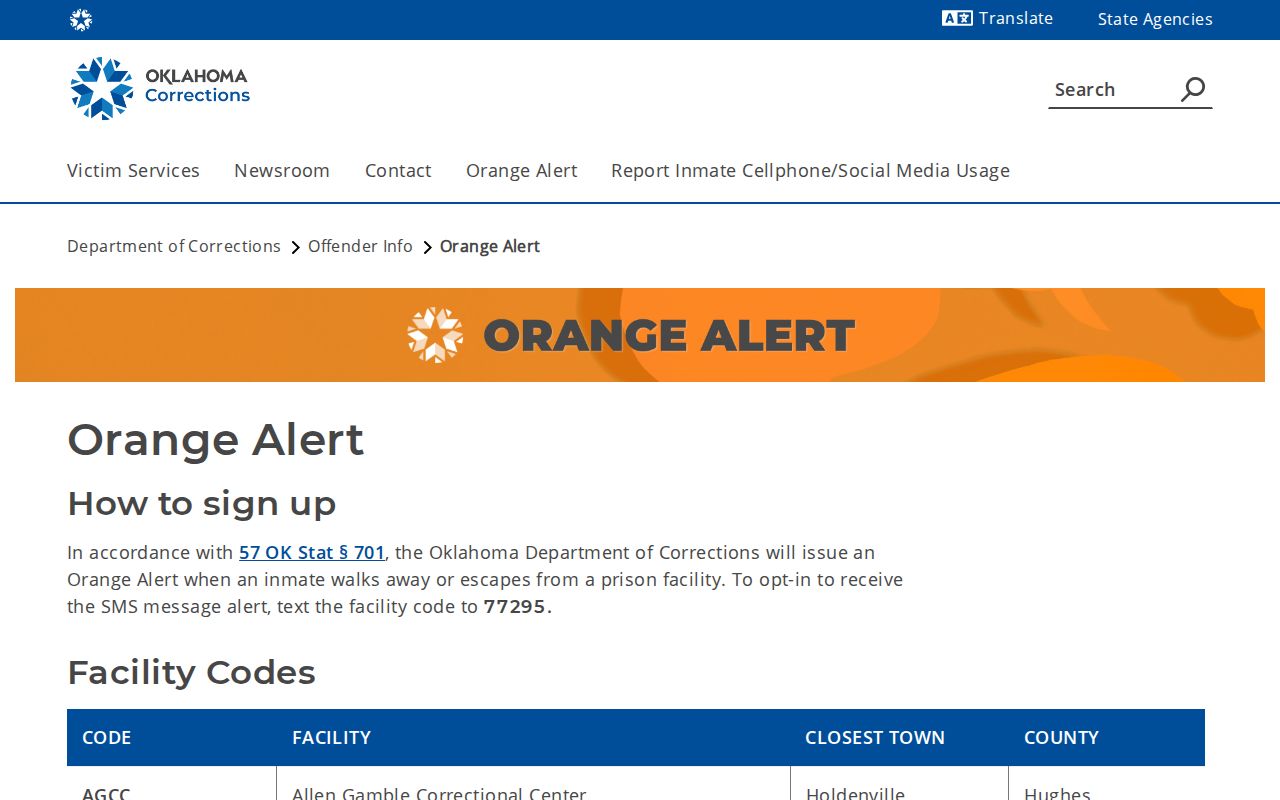
The screenshot helps distinguish a special state alert tool from the broad ODOC release and offender search needed for most Kay County cases.
Kay County ODOC Transfers
When KCDC sends a sentenced person to ODOC, two records describe different parts of the same movement. The Kay County record shows departure from the jail. The ODOC record shows reception into the state system. Under 57 O.S. § 95, the sheriff delivers the certified judgment and sentence and a certificate for post-sentence jail days, while ODOC's receipt is filed with the sentencing court clerk. The trail therefore runs through county custody, the court file, and state reception.
This sequence explains why “released by Kay County” can be technically true while “released to the community” is false. Ask the county for the release reason and receiving agency. Then check ODOC for the matching reception and current status. If ODOC later shows parole or discharge, verify that later state event on its own terms. Each custodian proves only the movement it controls.