
KCDC Release Destinations
Kay County Detention Center, also called the Kay County Justice Facility, records the point when its custody ends. The next event depends on the legal basis for confinement. A local detainee may return to the community after bond, recognizance, dismissal, a court order, time served, or completion of a county sentence. Others leave because another authority takes custody. That may be the Oklahoma Department of Corrections, another county with an active warrant, a federal agency, or ICE.
Ask for the release reason and the destination or receiving agency together. A departure time alone proves only that KCDC no longer held the person. “Transfer to ODOC” means state imprisonment began. Transfer to another jail, the U.S. Marshals Service, or ICE also means custody continued. Parole or probation means physical confinement may have ended while legal supervision remained. The Kay County released inmate search explains how county, court, state, and federal records fit together.
Note: A transfer closes Kay County custody but does not establish that the person entered the community.
Confirm a KCDC Release
No verified public KCDC roster, recent-release feed, or sheriff jail app was found on the official Kay County site. A released person may also vanish from a live custody list when the booking closes. For a recent event, begin with the detention facility and ask whether Kay County custody ended, the date and time of departure, the recorded release reason, and whether another authority received the person.
- Call KCDC with the full name, a useful identity detail, and the approximate booking date.
- Ask whether the event was community release or transfer, not merely whether the person is “not here.”
- Check ODCR for the Kay County court order, bond filing, judgment, dismissal, warrant, or later revocation.
- Search the named person through VINE and read “released” and “transferred” literally.
- Follow any transfer through ODOC, the receiving county, BOP, or ICE.
- Request the durable booking and release record when verbal confirmation is limited.
A court order explains the legal basis but may not match the actual door time. Another hold can keep custody in force after one case ends. Likewise, a VINE transfer notice confirms movement, not a return to the community. The strongest local proof is the custodian’s movement or liberation record showing date, reason, and destination.
KCDC Records and Contact
The official county contact route is direct because Kay County publishes no detention records form, records-desk hours, or county fee chart. A focused written request should identify one person, the booking or likely date range, and the exact event sought. Ask for the booking/release movement record, liberation instrument, release date and time, reason, and receiving agency if those fields are maintained and public. Request electronic copies and a cost estimate.
Kay County Detention Center
1101 W. Dry Road
Newkirk, OK 74647
Detention: 580-362-3393
Sheriff: 580-362-3250
Fax: 580-362-3259
Records hours are not published; call first.
The official Kay County Sheriff page is the source for these numbers. Telephone staff may limit what can be disclosed. If that happens, send a plain written request to the same address and ask for a written statutory reason for any redaction or denial.
Note: Use the booking number or birth date when available because a shared name is not enough to establish identity.
KCDC Release Record Fields
“Release record” is a practical label, not a promise that one standard public form contains every detail. A narrowly drawn request lets the custodian return the releasable parts of the booking, departure, and movement history. It also reduces the risk of confusing two people or two separate stays at the facility.
| Requested field | What it helps establish |
|---|---|
| Booked name, aliases, identifier | Whether the record concerns the right person and booking |
| Booking date and case number | The custody event and its linked court matter |
| Release date and time | When Kay County’s physical custody ended |
| Release reason or code | Bond, court order, time served, sentence completion, or transfer |
| Destination or receiving agency | Whether custody continued somewhere else |
| Hold or detainer agency | Why a person may not have entered the community |
Juvenile, sealed, expunged, medical, victim, security-sensitive, or active-investigation material may be withheld or redacted. Expungement means a court has ordered qualifying records sealed under Oklahoma law. It can explain why an older public entry is no longer visible, but it does not change the need to verify the current event with the lawful custodian.
KCDC Liberation Record Request
Oklahoma law supplies a precise route for a KCDC departure request. Under 57 O.S. § 62, instruments or attested copies by which a prisoner is committed or liberated must be endorsed, filed, and safely kept by the sheriff or deputy jailer. Asking for the “§ 62 liberation instrument” is more exact than asking for an unofficial list of recent releases.
The Oklahoma Open Records Act also governs access to nonconfidential government records. Ordinary pages may cost up to 25 cents each and certified pages up to one dollar each. A lawful search fee is limited to requests made solely for a commercial purpose or those that clearly cause excessive disruption. The law calls for prompt, reasonable access but does not create a fixed number of days for this request.
Keep the request narrow. Include a full name, date of birth or booking number when appropriate, and an estimated booking range. Ask for reasonably segregable portions, meaning the public parts that can be separated from protected material. Do not ask for a mass list or biometric data. A booking photograph, if wanted, should be requested as a separate item tied to the same booking.
KCDC ICE Release Paths
KCDC is unusual because the same Newkirk site serves local criminal detention and ICE contract detention. The official ICE facility listing and the federal intergovernmental agreement confirm this role. An immigration detainee can physically leave KCDC yet remain in ICE custody at another facility. Departure may instead reflect release through immigration process or removal from the United States.
Use the ICE Online Detainee Locator System with an A-number and country of birth, or with exact biographical details. ICE states that the locator includes current detainees and some people released from ICE custody within the prior 60 days. No result can have several causes, including spelling, a transfer, data limits, release, removal, or an event outside that recent window. Contact ICE Enforcement and Removal Operations when the locator does not settle the outcome.
A detainer is an agency request or basis to hold or transfer a person after another custody ground ends. It is not itself proof of community release. County records show the KCDC departure; ICE records determine what happened next in immigration custody.
Note: Never infer immigration release from the disappearance of a name from a county source.
KCDC History and Custodians
Kay County says the current sheriff and detention complex opened in December 2010. The public-facing contact comes through the Sheriff’s Office, while federal inspection material identifies an operating role for the Kay County Justice Facilities Authority. Its public agendas and minutes offer a record of local operations that is distinct from any person-specific release file.
The facility’s role has crossed several jurisdictions. A 2020 Authority action documented a Kaw Nation detention agreement. Historical KCDC-supplied local reports also used municipal, highway patrol, tribal or BIA, DOC, warrant, sanction, and bond categories. Those sources explain why a departure can lead to another sovereign rather than to the street. They do not prove a named person’s current status.
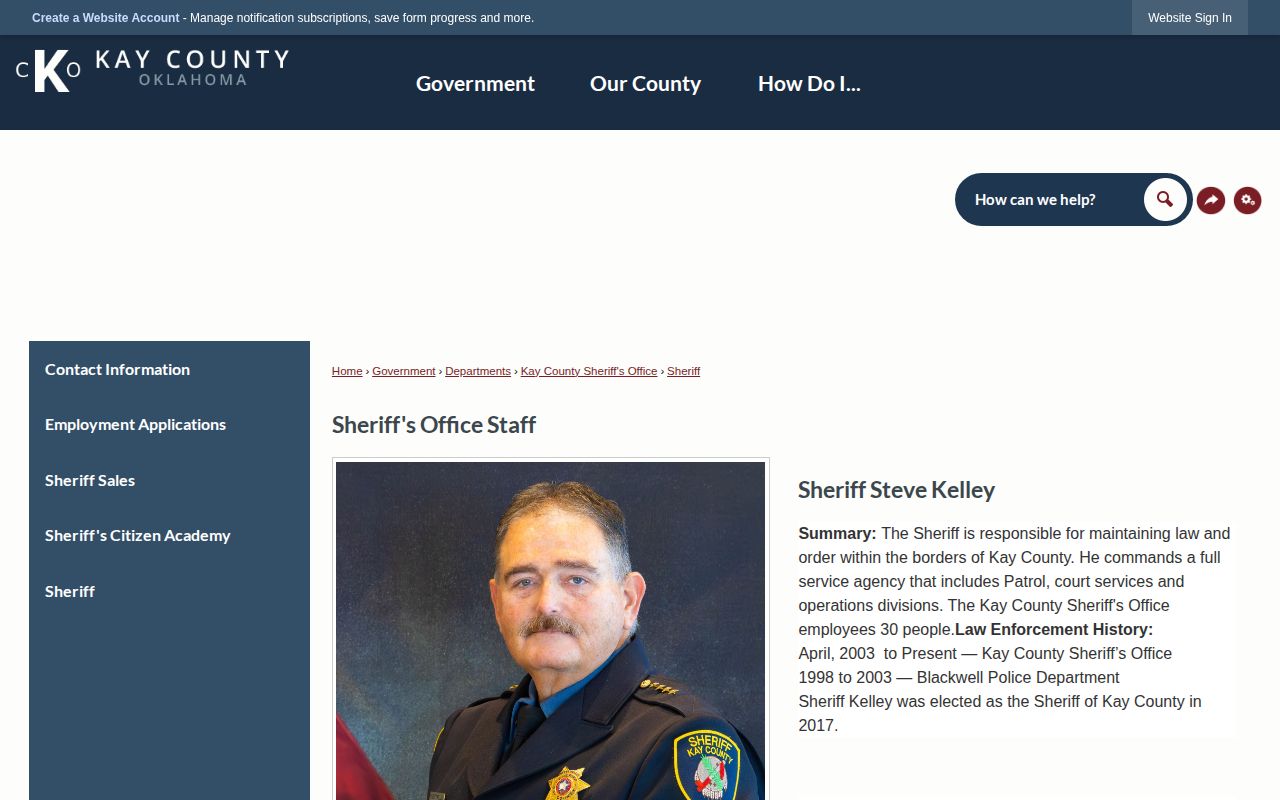
The official sheriff history page is the matched source shown below.
KCDC Departure Entry Evidence
September 2024 Justice Facilities Authority minutes reported that KCDC used an iris-scan positive-identification system on inmate arrival and departure. The minutes also recorded an August high population of 395, an average daily population of 372, and a “count for August” of 515. That last label must remain exact. The source does not call it a release or booking total.
The iris system is useful here for one limited reason. It supports asking the custodian for the ordinary departure, release, or movement entry despite the lack of a public web feed. It does not support requesting biometric templates or publishing biometric data. The public-record inquiry concerns the documented custody event: who left, when KCDC custody ended, why the person departed, and which authority received the person.
Read operational minutes as context, not as a substitute for an individual record. The minutes can show how the facility logs movement and how the Authority oversees operations. Only a record tied to the named booking can verify one person’s release or transfer.