
Federal BOP Release Scope
The Federal Bureau of Prisons holds sentenced federal prisoners across the country. No standalone BOP prison was verified physically within Kay County. The federal locator still matters for Kay County because a federal defendant can be held temporarily in a local contract setting, moved through U.S. Marshals Service custody, and later committed to BOP. Those events belong to different record keepers. A departure from a Kay County host facility does not establish a BOP release, and a later BOP release does not supply the earlier county departure time.
BOP's public locator covers federal incarceration records from 1982 forward. It is the correct first search for a sentenced federal prisoner. Federal pretrial custody is different. The U.S. Marshals Service can hold defendants from a court's detention order until release, acquittal, or delivery to BOP after conviction, often through contracted facilities. No public USMS released-prisoner locator was identified. A federal court docket and release order are the better path for a pretrial release.
Search Federal BOP Releases
The official BOP Inmate Locator supports two basic methods. Number search accepts a BOP register number and other listed federal identifiers, including DCDC, FBI, or INS numbers. A name search accepts first, middle, and last name with age, race, and sex refinements. Use the number when it is known. It sharply lowers the chance of selecting a person with the same or a similar name.
- Open the official BOP locator and choose number or name search.
- Enter the full federal identifier, or use the exact name and offered refinements.
- Compare the returned name, register number, age, race, and sex.
- Read the location and release-date columns without changing the agency's wording.
- When the result says Released or Not in BOP Custody, check for another custody system.
- Review the federal case docket for the sentence and supervised-release term.
A federal release lookup does not verify a routine KCDC release. If the person was only booked by Kay County, never sentenced federally, or held under another authority, the BOP search may have no record. Start with the known arresting and receiving agencies. The full Kay County release-record route helps separate the local, state, federal, and immigration trails.
Note: A number search is more precise than a name search, but the returned identity details should still be checked.
Read Federal BOP Release Results
The BOP results table can show the person's name, register number, age, race, sex, release date, and location. These fields answer a narrow question: what does the Bureau of Prisons report about its own custody? The location may identify a current BOP facility. A released status may appear without a facility. Each result should be tied to the right person through the register number and several identity details, not a name match alone.
| BOP field | What it establishes |
|---|---|
| Register number | The principal identifier for the federal incarceration record. |
| Name and profile details | Identity checks that help distinguish people with similar names. |
| Location | The BOP facility when the person remains in Bureau custody. |
| Release date | The date attached to BOP's end-of-custody record or calculation. |
| Released / Not in BOP Custody | BOP custody ended; another form of custody or supervision may continue. |
BOP expressly limits the meaning of a released result. “Released” or “Not in BOP Custody,” with no facility shown, means only that the person is no longer held by BOP. The person may be in another correctional or law-enforcement system. The person may also be serving a federal supervised-release term in the community. Supervised release is a court-imposed period overseen after prison; it is not the same as BOP confinement.
Note: BOP's released status ends Bureau custody only; the federal docket and receiving agency can show supervision or another custodial hold.
Federal BOP Locator View
The official BOP locator search endpoint is the manifest-approved visual source for the federal release route. Its search form and returned table should be read as Bureau records, with the agency's limits kept intact.
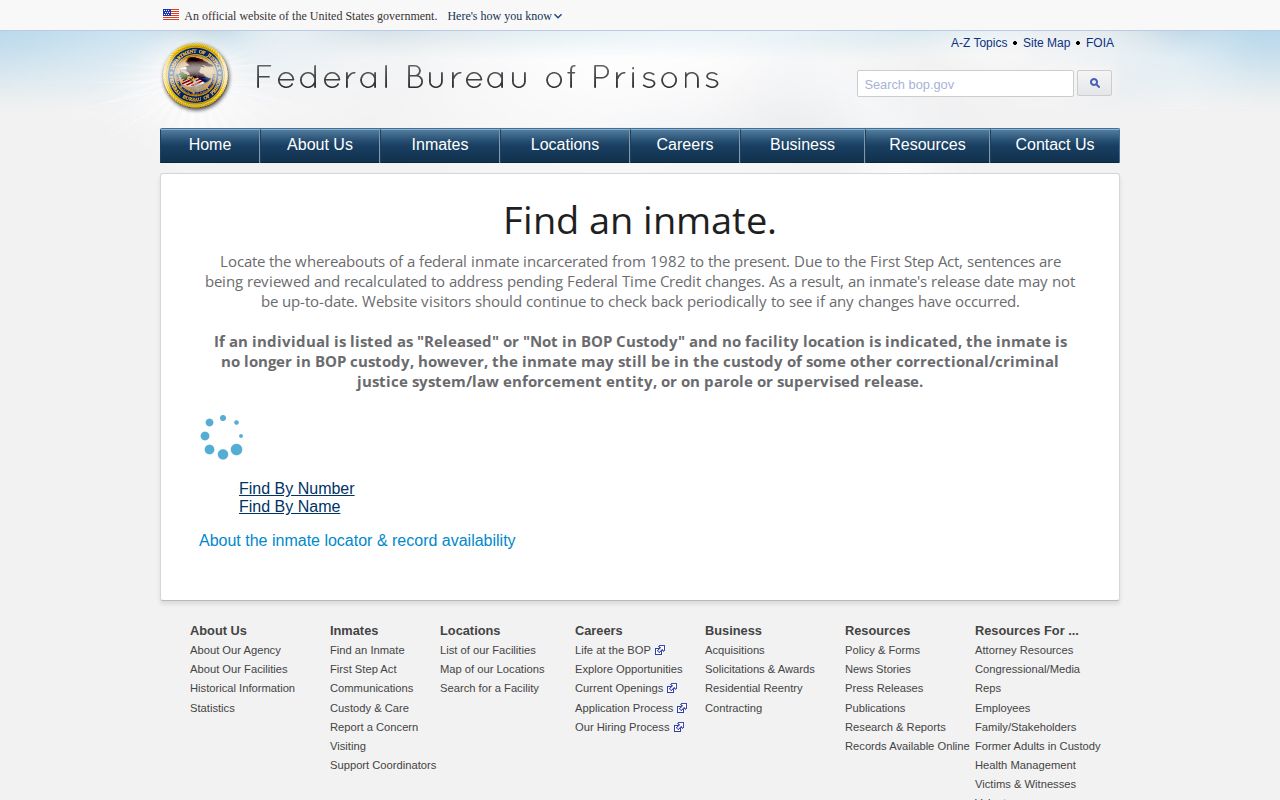
The screenshot shows the federal tool that should replace a county roster when the relevant event is a completed BOP sentence or other BOP custody history.
After a Federal BOP Release
A BOP release can lead to several outcomes. The person may return to the community and begin supervised release. Another authority may take custody under a warrant, detainer, or sentence. A detainer is a notice that another agency seeks custody when the present hold ends. Immigration detention may also follow. None of these outcomes can be resolved by rewriting “Not in BOP Custody” as “free.” Follow the receiving agency named in the available record.
The federal court docket is the key companion source. It records the judgment, term of imprisonment, and term of supervised release, plus later modifications or revocation action. PACER access and the clerk of the sentencing court serve that function. U.S. Probation addresses supervision, while BOP addresses prison custody. If the person was transferred into state or local custody, search that custodian next. If ICE took custody, use the ICE locator and ERO route.
- BOP custody
- Confinement controlled and reported by the Bureau of Prisons.
- Supervised release
- A federal court term served in the community after incarceration.
- Detainer
- A request from another authority that can produce a transfer when BOP custody ends.
- Discharge
- The end of the particular legal term confirmed by the responsible authority.
A projected federal release date can also change. BOP warns that First Step Act sentence recalculations may affect dates. Court action, sentence credit, and a later hold can alter the practical outcome. Recheck the official record close to the expected event and distinguish the projected date from the completed release field.
Kay County Federal Custody
The U.S. Marshals Service prisoner-custody overview explains its role between a federal court order and delivery to BOP. USMS may use state, local, and private detention space. That can place a federal defendant in a host facility without turning that site into a BOP prison. The custodian of the host facility can document the local departure, but the federal docket or USMS route must explain whether the departure was release or transfer.
For a Kay County inquiry, begin with the custody stage. A local booking record answers when KCDC custody ended. The federal court order answers whether a judge ordered release or detention. BOP answers the later prison history after commitment. If the person left KCDC for federal custody, a county release code alone does not show community release. Follow the federal case and the agency that received the person.
Federal BOP Release Records
The public locator is often enough to confirm the recorded end of BOP custody. A more complete matter may require the sentencing court record or a request to the federal agency. Keep the request narrow. Supply the full name, register number, date of birth, case number when known, the type of record, and a date range. Ask for the release or custody-history material that the agency can disclose rather than demanding a broad prison file.
Federal release sources
BOP inmate locator: Official federal search
USMS custody information: Official prisoner overview
Court record: Sentencing court docket and clerk
Supervision: U.S. Probation for the federal district
The systems should agree on sequence, not necessarily on wording. A court release order may precede the actual departure. BOP records the end of its own custody. U.S. Probation records community supervision. A later state or immigration hold belongs to that receiving agency. Keeping each fact with its custodian produces a defensible federal release history.
For a historical Kay County connection, preserve the full sequence in the request. Identify the local detention dates, the federal case number, the register number, and the approximate BOP release date. Then ask each office only for the part it maintains. KCDC can address its facility movement. The federal clerk can provide the judgment and later orders. BOP can address incarceration and its release field. U.S. Probation can route a question about an active federal supervision term. This division avoids asking one office to certify events controlled by another.
If a locator result appears inconsistent with a court record, compare dates before assuming an error. A judgment date, commitment date, admission to a designated institution, projected release date, and physical release date describe different points. A federal prisoner may also receive credit for prior official detention under federal sentence rules. The public table is not a complete sentence computation. Use it to identify the correct person and recorded BOP outcome, then seek the controlling court or agency record for the disputed point.
Note: The federal locator is not a current Kay County jail roster and cannot certify a county booking or release.