
Kay County Release Meanings
A Kay County release is the end of custody by one named agency. It does not always mean that the person walked into the community. Someone leaving the Kay County Detention Center may be freed on bond, released after time served, sent to the Oklahoma Department of Corrections, moved to another jail, or transferred under federal or immigration authority. The record trail changes with that event. The county jail keeps its own booking and movement record. ODOC keeps state sentence and custody history. BOP records federal custody, while ICE controls immigration detention information.
A released person normally drops from a live jail roster because that roster describes who is held now. Kay County does not publish a verified official roster or recent-release feed. That makes a missing name even less useful as proof. The strongest local evidence is a custodian-produced movement or liberation record that identifies the person, the date and time, the reason, and any receiving agency. A VINE event or court order can support it, but each source answers a different question.
- Release
- The named agency ended its custody, either to the community or through a transfer.
- Discharge
- The relevant sentence or period of supervision ended.
- Time served
- The custodial part of a sentence was satisfied, though another duty or case may remain.
- Detainer
- A request or hold from another authority that may prevent a community release.
Kay County Release Types
The release code matters more than the fact that a name disappeared. Bond or recognizance permits a person to leave jail while the case continues. A dismissal or court order may end the local basis for custody, yet a separate hold can still cause a transfer. Parole and probation also require care: both can place a person in the community under legal supervision. They are not the same as a full discharge.
| Release or movement | What it means | Where to verify next |
|---|---|---|
| Bond or pretrial release | County custody ends while the criminal case remains open. | KCDC movement record and Kay County court docket |
| Time served or sentence complete | The local custodial term ends, subject to any other hold. | Release instrument, judgment, and later docket entries |
| Transfer to ODOC | Kay County custody ends but state incarceration begins. | County departure, court filing, and ODOC reception |
| Another jail or federal transfer | Custody continues with a different authority. | Receiving jail, BOP, USMS court record, or VINE |
| ICE movement | Departure may mean transfer, immigration release, or removal. | ICE locator and ERO, not the county roster |
| Parole or probation | Physical custody may end while supervision continues. | ODOC status, PPB result, and the judgment |
Can a transfer be called a release? It is a release from the sending agency, but it is not a community release. Always record the destination or receiving authority.
Note: The release code and receiving agency distinguish a community departure from custody that continued beyond Kay County.
Kay County Release Record Fields
Kay County has not published a public field guide for its jail system. A narrow request should therefore ask for the fields maintained for one named booking instead of asserting that a standard form exists. Identity must be checked with more than a name. Full name, aliases, date of birth, booking number, and court case number help separate people who share similar names. The event fields then show when county custody ended and what happened next.
| Requested field | What it can establish |
|---|---|
| Booked name and aliases | The identity used in the Kay County booking |
| Booking or inmate number | The exact local custody event tied to the request |
| Booking date and arresting agency | When and how Kay County custody began |
| Charge, case, and bond data | The legal matter and a possible basis for pretrial release |
| Release date and time | The recorded end of KCDC custody |
| Release reason or code | Bond, court order, time served, transfer, or another outcome |
| Destination or receiving agency | Whether custody continued elsewhere |
| Booking photograph | The image tied to that booking, if maintained and releasable |
The court docket is not a substitute for these movement fields. A case marked disposed may still involve a sentence, hold, or later revocation. Likewise, a projected release date is a forecast, not proof that the person left the facility. Ask for the actual release or movement transaction when the exact event matters.
Request Kay County Release Records
Kay County publishes no dedicated detention-record request form, named records custodian, release-record fee chart, or fixed turnaround. A plain written request can be sent to the Kay County Sheriff's Office or Kay County Detention Center. Keep it narrow. Identify one person and a short booking range, ask for electronic copies, and request a cost estimate before fees accrue. Oklahoma law promises prompt, reasonable access rather than a fixed number of days.
- Identify the person with full name and, if known, date of birth, booking number, or case number.
- State the approximate booking range and ask for the booking/release movement record and the liberation instrument kept under state law.
- Request the release date and time, release reason, destination, receiving or hold agency, and booking photograph if those fields exist and are public.
- Ask for electronic delivery, advance notice of fees, and reasonably separable public portions if any material is withheld.
- If the request is denied or redacted, ask for the specific legal basis in writing.
1101 W. Dry Road
Newkirk, OK 74647
Sheriff's Office: 580-362-3250
Detention Center: 580-362-3393
Fax: 580-362-3259
Juvenile, sealed, expunged, medical, victim, security-sensitive, and some active investigative material may be restricted or redacted. The custodian must determine what exists and what can be released. No public Kay County online retention period was found, but loss of online visibility is not the same as destruction of the underlying record.
Note: Electronic delivery and a narrow date range can reduce copying work, but Kay County publishes no fixed response deadline.
Kay County Release Record Law
The Oklahoma Open Records Act, 51 O.S. §§ 24A.1 through 24A.33, sets the general public-access rules. Section 24A.3 defines records broadly, including photographs and data files. Section 24A.5 addresses access, copies, certification, redaction, fees, and prompt production. Ordinary pages up to the stated size may cost no more than 25 cents per page, while certified pages may cost up to one dollar. Search charges are limited by the law and are not a universal charge for every request.
Under 57 O.S. § 62, commitment and liberation instruments or attested copies must be endorsed, filed, and safely kept by the sheriff or jailer.
That specific rule supports a request for the instrument that authorized release, not just a screen print from a current roster. Oklahoma's law-enforcement-record provisions and other confidentiality laws still apply. Expungement under 22 O.S. §§ 18 and 19 can seal qualifying official criminal records after a court order. Eligibility is fact specific. A sealed public view may therefore no longer show an event that occurred, and an old private copy should not be treated as the current official record.
Kay County Release Court Trail
Kay County's own Court Clerk directs district-case searches to ODCR. Search by case number when possible, then inspect bond filings, pleas, judgments, jail-credit entries, dismissals, warrants, recalls, revocation filings, and later sealing orders. The docket often explains why a judge or prosecutor changed the legal basis for detention. It does not record the exact moment that KCDC completed its checkout process.
Municipal cases follow a separate trail. Ponca City ordinance matters use the Ponca City Municipal Court, and city police offer their own records-request route. Blackwell and Tonkawa matters may also remain with municipal custodians. A city arrest can end before county booking, so absence from the Kay district docket or KCDC cannot prove that no custody event occurred.
Note: A court order explains authority for release, while the Kay County jail record supplies the physical departure time and destination.
Kay County ICE Release Paths
Kay County's Newkirk detention site is also listed by ICE as a contract facility. This shared address creates a special verification problem. A person can leave county-managed space but remain in immigration custody at a different facility. The departure could also reflect release under immigration process or removal from the United States. Neither ODOC nor a county case docket can distinguish those outcomes.
Use the ICE Online Detainee Locator System with an A-number and country of birth, or with exact biographical details. ICE states that the locator includes current detainees and certain people released from ICE custody within the prior 60 days. No result may reflect spelling, the passage of that window, transfer, restricted data, release, or removal. Contact ICE Enforcement and Removal Operations when the public locator cannot resolve the event.
The official ICE Kay County facility listing confirms the federal relationship. It does not turn an immigration movement into a county criminal release.
Kay County Facility Release History
The county states that the current sheriff and detention complex opened in December 2010. Justice Facilities Authority records and federal inspection material show why a Kay County departure may involve more than one government. A 2020 Authority action documented a Kaw Nation detention agreement, while current federal sources identify ICE use. Historical KCDC-supplied status reports also included municipal, highway patrol, tribal or BIA, ODOC, warrant, sanction, and bond categories.
That local mix changes the best question. Do not ask only whether the name is still at KCDC. Ask which authority controlled the next movement. If the answer is ODOC, use the state record. If another county accepted the person, contact that jail. Federal criminal custody points to BOP or the federal court, and immigration custody points to ICE.
Kay County Release Departure Scans
September 2024 Justice Facilities Authority minutes report that KCDC used iris scans for positive identification on inmate arrival and departure. The detail supports asking the custodian for the ordinary departure entry because the local operation records a checkout event. It does not support requesting or publishing a biometric template. A purpose-neutral records request should seek the movement history, liberation instrument, release reason, and destination instead.
The same minutes reported a high population, average daily population, and a separate monthly count. Those labels should not be recast as release totals. They describe facility operations, not a public list of Kay County released inmates. The absence of a web feed remains unchanged.
Note: The documented iris process supports requesting an ordinary departure entry, not a biometric record or an inferred release count.
Find Kay County Released Inmates
A reliable search starts with jurisdiction. Determine whether the relevant event involved a municipal arrest, KCDC booking, ODOC sentence, federal sentence, or ICE detention. Use a case number, booking number, ODOC number, federal register number, or A-number when available. These identifiers reduce mistaken matches and point toward the right custodian.
- Check the system that keeps historical status: ODOC for a state sentence, BOP for a federal sentence, ODCR for a Kay district case, or the correct municipal court for a city matter.
- Search OK VINE for the named person and reporting agency. Read “released” and “transferred” literally.
- Call KCDC at 580-362-3393 for a recent local event and ask when custody ended, why it ended, and whether another agency took custody.
- Read the court record for the order, bond event, judgment, dismissal, warrant, or revocation that may explain the legal basis.
- Submit a focused records request for the movement and liberation record when the online and telephone paths do not provide durable proof.
- Follow the destination. Search ODOC, the receiving county, BOP, or ICE rather than stopping at “not here.”
A released person usually leaves a live roster. No match proves only that the searched system does not show the person now.
The Kay County 24-hour release fallback focuses on same-day checking when no official feed exists. For one named person, the full sequence above supplies stronger context and a record trail.
ODOC Kay County Release Search
The ODOC Public Inmate Data search is the first online path for a person who entered Oklahoma state custody. It is not a Kay County jail roster. A short county booking, county sentence, or municipal arrest may never create an ODOC record. Search by ODOC number when known. Otherwise, search by name and compare the photograph, date of birth, sentence, case, and agency clues before accepting a match.
| Search or record field | How to use it | Caution |
|---|---|---|
| ODOC number | Use as the most exact public search key. | It does not identify a county-only booking. |
| Name | Find candidate records when the number is unknown. | Never match on name alone. |
| Photo and identity data | Compare the returned person with known facts. | The ODOC photo is not necessarily the KCDC booking image. |
| Status or location | Separate prison custody, supervision, fugitive status, and discharge. | A supervision office is not a prison location. |
| Projected release date | Read the official forward-looking estimate. | It is tentative, not an actual departure time. |
| Sentence history | Connect the record to the right Kay County case. | An old discharge does not settle a later sentence. |
The official lookup requires acceptance of a disclaimer and warns that its data is abbreviated. ODOC policy confirms that the public system can present offense data, a projected release date, and a photograph. For certified or completed discharge proof, use the ODOC Legal Services open-records form or the discharge contact listed by ODOC.
The official ODOC search screen shows the state portal used for this check.
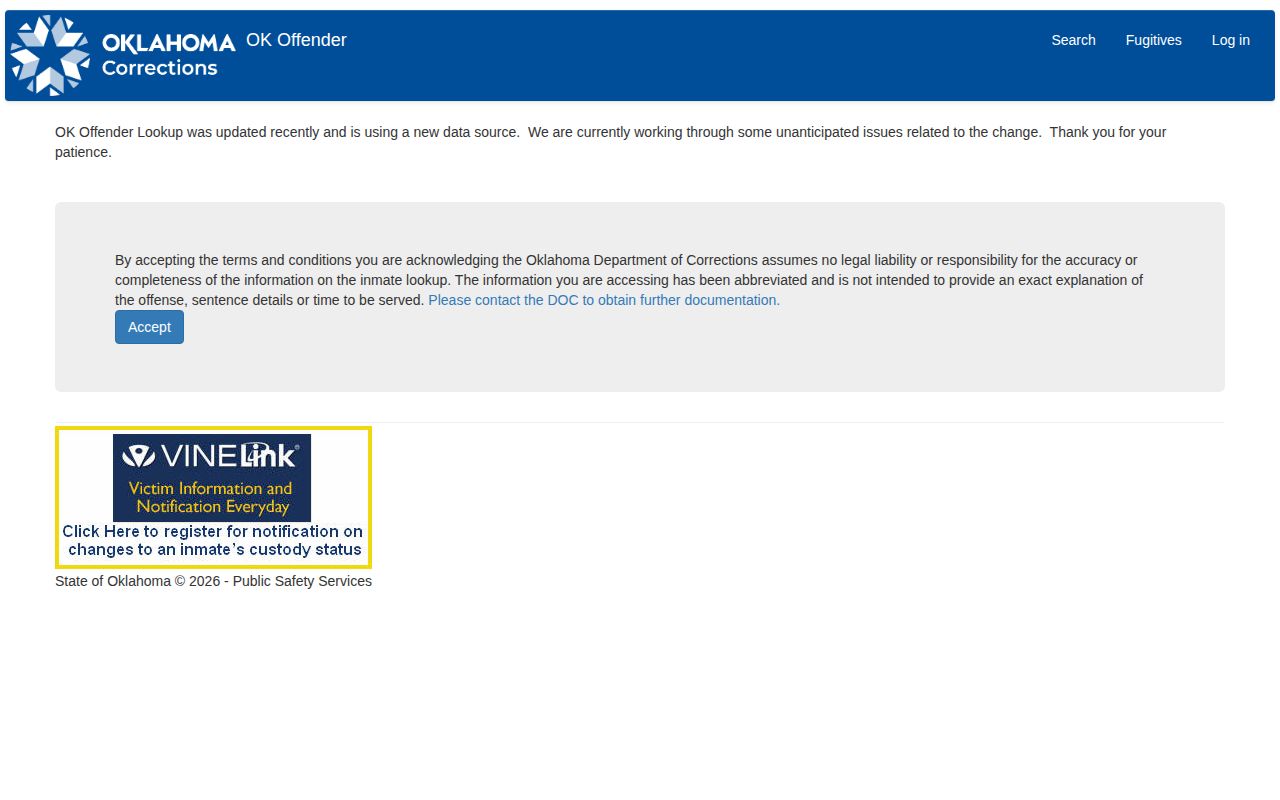
Its state scope is why a missing ODOC result cannot disprove a Kay County jail release.
Note: ODOC history applies only after state-system involvement and cannot replace the record of a county-only jail stay.
Kay County Recent Release Fallback
The official Kay County Sheriff's Office page and county sitemap expose no verified current roster, 24-hour release view, 72-hour release view, booking-photo archive, or sheriff jail app. There is no official feed URL, known list of fields, update schedule, retention window, or published photo behavior to report. Private sites with official-sounding Kay County names do not fill that gap.
For a same-day event, call the detention center. Staff may limit what can be confirmed by telephone, so follow with a written request for the booking/release movement record. Ask three things: the date and time county custody ended, the release reason, and the next authority or destination. OK VINE can supply an event notice, while ODCR can show a court basis. Neither replaces the jail's own departure record.
Kay NewsCow preserves dated historical KCDC-supplied reports with labels such as bond release, another-agency hold, BIA contract, weekend commitment, sanction, and DOC sentence. Those reports help interpret older events, but they are not a complete or current official release archive.
Kay County Release Supervision
Release to parole or probation is not full discharge. The Oklahoma Pardon and Parole Board makes parole decisions or recommendations, while ODOC supervises parolees and probationers in the community. The local Ponca City Probation and Parole office serves Kay, Grant, and northern Noble Counties. ODOC publishes no walk-in hours or online check-in process for that office, so callers should contact it before visiting.
Verify the person in the ODOC search, read any community status or office location, and compare the Kay County judgment. A Board docket shows that a matter was set for review. Validated results show the decision, yet even a favorable result may not be the physical gate date. The separate Kay County probation and parole resource covers supervision checks, PPB results, and ODOC fugitive status in detail.
Discharge means the relevant sentence or supervision term ended. If a record says only “released to parole,” continued ODOC authority should be expected.
Note: A parole decision, physical prison release, community supervision, and final discharge can each carry a different date.
Federal Kay County Release Checks
OK VINE is useful for custody events reported by participating Oklahoma agencies. The state describes it as a free, confidential service with web, mobile, phone, text, email, in-app, and TTY options. Kay County Detention Center and the local police departments appear in OSBI's ODIS participation inventory, though participation does not guarantee that each event is instant or complete. A VINE transfer means custody continued elsewhere.
Federal prison records require the BOP Inmate Locator. Search by register or other federal identifier when possible, or use exact biographical details. BOP results can show a release date and “Released” or “Not in BOP Custody.” BOP warns that this establishes only the end of its custody. Another system or federal supervised release may still apply. The federal docket and U.S. Probation address those terms.
No public USMS released-prisoner locator was found. A federal pretrial release should be checked in the federal court record, while a sentenced prisoner belongs in BOP's system.
Kay County Custody Status Comparison
Each system answers a limited question. Using the wrong one can turn a transfer into a false claim of release or make a county-only event seem to vanish.
| System | Best use | What absence or status cannot prove |
|---|---|---|
| KCDC contact and release record | Recent county custody, departure time, reason, and destination | A transfer does not mean community release |
| ODOC Public Inmate Data | State sentence, prison status, supervision, projection, or discharge history | No result does not disprove a county-only booking |
| ODCR and municipal courts | Orders, bonds, judgments, dismissals, and later case events | “Disposed” is not an exit timestamp |
| OK VINE | Reported custody status and event notifications | A transfer is not release to the community |
| BOP | Federal custody since 1982 and BOP release status | End of BOP custody does not end all legal supervision |
| ICE ODLS | Current and certain recent immigration custody situations | No match does not prove release, removal, or no prior custody |
Note: Confirm identity, source agency, event date, release type, and destination before treating any online status as a completed release.
Kay County Release Facilities
The Kay County Detention Center is the documented local jail and also holds some people under other agreements. City police holding functions are short-term arrest and processing paths, not verified independent long-term jail databases. State, federal, and ICE systems remain part of the facility map because a Kay County departure may lead into one of them.
- Kay County Detention Center: call or request its movement record, then follow any named receiving agency.
- Ponca City Police Department Holding: check police and municipal records, then KCDC if a transfer occurred.
- Blackwell Police Department Holding: confirm city release or county transfer with the relevant custodian.
- Tonkawa Police Department Holding: use municipal records and KCDC only if county booking followed.
- Oklahoma Department of Corrections: use the statewide offender record for prison, supervision, and discharge history.
- Federal Bureau of Prisons: use the national locator for the end of BOP custody.
- Kay County ICE Detention: use ICE ODLS and ERO to distinguish transfer, immigration release, and removal.
There is no verified standalone ODOC prison or BOP institution physically in Kay County. Their pages explain the receiving systems that can become relevant after a local transfer. Juvenile detention records are restricted and are not part of this adult release workflow.